Dividends are one of the most talked-about — and most misunderstood — topics in personal finance.
They’re misunderstood mostly because they feel like free money.
Cash shows up in your account.
No shares sold.
No visible downside.
And people get emotionally attached to that feeling.
But dividends aren’t a free lunch. They’re just a different way a return is delivered.
When a dividend is paid, the company’s value drops by the same amount. In theory, the stock price drops too. That’s the math.
The reason most people don’t notice is volatility.
Markets move every day for a hundred different reasons. That small price adjustment gets lost in the noise, so the dividend feels like a bonus instead of what it actually is — part of your total return.
So investors stick with their perception of dividends, even though mathematically, nothing extra was created.
For some investors, dividends feel tangible.
Reassuring.
Like progress you can see and count.
And because of that, many people build their entire investment strategy around them.
That’s not always a great idea.
This post is split into two parts:
- Why investors chase dividends — and how that focus can quietly hurt them
- The Dividends That Actually Matter
This isn’t a dismissal of dividends — it’s a critique of dividends as a sole or dominant strategy.
Disclaimer: I personally invest XDIV, VYM, VIG, and several individual dividend stocks.
Part 1: Why Do Investors Chase a Subset of “Good” Companies?
People chase dividends for the same reason they feel so compelling in the first place.
They’re tangible.
They’re easy to track.
Cash shows up. Progress feels real.
Dividend investing also feels active. Intentional. Like you’re doing something. You’re picking companies. Building a list. Watching payments roll in.
And stock picking is fun.
But every trade has two sides. For every decision you make, there are thousands — often millions — of other investors on the other side of that trade who think they know just as much, or more, than you do.
Dividends feel safe.
They feel like success.
But investing doesn’t reward feelings.
It rewards math, diversification, and time.
Where Dividend Investing Breaks Down
1. Lack of Diversification
When you focus on dividend-paying companies, you automatically exclude a large portion of the market.
Many great businesses don’t pay dividends because they’re reinvesting in growth. By filtering them out, you miss entire sectors, innovation, and long-term compounding opportunities.
“If you like everything in your portfolio, you’re not diversified enough.”
— Dan Bortolotti (The Canadian Couch Potato)
2. Selection Bias
Dividend investing is still stock picking — just with a nicer label.
You’re choosing companies based on a specific characteristic rather than owning the market itself. The problem?
You can’t reliably pick winners ahead of time.
Index investing doesn’t ask you to be right.
It just asks you to participate.
3. Poor Optimization
All of the above leads to sub-optimal portfolios.
You may be taking on more risk, not less — just in a way that’s harder to see.
Concentration risk.
Sector risk.
Missed growth.
None of these show up neatly on a dividend tracker.
Focusing exclusively on dividend-paying stocks doesn’t reduce risk — it reduces opportunity.
4. The Dividend Income Illusion
Many people track dividends against their cost of living.
Once dividends cover expenses, the logic goes: “My money will last forever. I’ll never have to sell a share.”
Sounds fantastic. But here’s the uncomfortable truth: That often means you over-saved.
You left years of time, freedom, and experiences on the table — years you could have been living more fully — because you waited for a number that never actually needed to be hit.
5. You Don’t Need Dividends to Create Income
That’s the entire point of retirement planning (or decumulation).
A portfolio is meant to be used.
Selling shares isn’t failure — it’s design.
Dividends can help, sure. But waiting until dividends alone cover your expenses often means working longer than necessary, in a job you might already be done with.
The nest egg isn’t a trophy. It’s fuel to live a fulfilling life.
Dividend investing doesn’t fail because dividends are bad. It fails when investors mistake income for return.
A Quick Caveat on Balance
This isn’t a callout against never seeking dividends.
It’s a callout against dividends as an only strategy.
I own a few individual dividend-paying stocks. I also hold a couple of dividend ETFs. They’re fine. They serve a purpose. But they’re not the focus of my portfolio.
In total, they make up less than 5% of my investments.
The core of my portfolio is index-based. Broad. Boring. Effective.
That balance matters.
For most people, having a small portion of their portfolio set aside to learn, experiment, or scratch the stock-picking itch is perfectly reasonable.
Call it “play money.”
Call it “learning capital.”
Up to 5–10% of a portfolio is fine if:
- you enjoy it
- you understand the risks
- and you accept that it’s not where your long-term results will come from
The problem isn’t curiosity.
The problem is building your entire financial future around a narrow strategy because it feels good.
Index investing does the heavy lifting.
Everything else is optional.
What’s Lost by Focusing Only on Dividends
Dividends aren’t the whole picture.
Total return = price growth + dividends.
Historically, about 70% of long-term stock market returns come from price appreciation, and about 30% from dividends.
When you focus exclusively on dividends, you’re anchoring your strategy to the smaller piece of the return equation.
And while most large companies do pay some dividend, many of the highest-growth companies either pay none or very little, because they reinvest internally.
That reinvestment is often what drives long-term wealth.
S&P Global: “Since 1926, dividends have accounted for ~31 % of U.S. stock market total return, with price appreciation making up the other ~69 %. That’s not opinion — that’s data.” https://www.spglobal.com/spdji/en/research/article/a-fundamental-look-at-sp-500-dividend-aristocrats
RBC Global Asset Management: “Over the past 30 years in Canada, dividends have contributed about 30 % of total equity returns, meaning most wealth has come from growth.” https://www.rbcgam.com/en/ca/learn-plan/investment-basics/made-in-canada-dividends-the-opportunity-for-income-investors/detail
MoneyWeek: “Studies have shown dividend-focused indexes often underperform broader benchmarks by a couple percentage points per year over long periods.” https://moneyweek.com/investments/dividend-stocks/how-to-harness-the-power-of-dividends
The Math Doesn’t Care About Your Feelings
A dividend-only investor typically gives up 1–3% per year in expected long-term returns, depending on how strict the dividend filter is.
That doesn’t sound like much until time gets involved.
Sure Dividend: “Dividend-heavy indexes can lag broad market benchmarks over multi-year periods — particularly when growth stocks lead.” https://www.suredividend.com/dividend-aristocrats-list
Advisor Perspective: “Dividend payers don’t consistently produce alpha, meaning they don’t systematically beat the total market.” https://www.advisorperspectives.com/articles/2023/03/13/the-evidence-against-favoring-dividend-paying-stocks
O’Shaughnessy Asset Management: “High yield segments don’t reliably outperform, and in some decades can underperform broad equities.” https://www.osam.com/pdfs/research/_34_OSAM_research_DivYield-vs-DivGrowth_Sep12.pdf
Why This Happens
Dividend-only investing introduces three structural drags:
1. Excludes non-dividend growth companies
Tech. Biotech. Innovative firms.
These have historically driven disproportionate market growth.
2. Tilts toward mature, slower-growth businesses
Banks. Utilities. Pipelines. Telecom.
Stable cash flows — lower reinvestment rates.
3. Reduces reinvestment compounding
Dividends leave the company.
Growth firms compound internally before you ever see the return.
“But I reinvest my dividends.”
The dividend still left the company. Reinvestment doesn’t reverse that.
When a dividend is paid:
- Cash leaves the company’s balance sheet
- The company is worth less by that amount
- The stock price adjusts accordingly
What you do with the cash afterward — spend it or reinvest it — is a separate transaction.
Reinvesting a dividend does not:
- Put the money back into the company
- Increase the company’s capital
- Fund growth or innovation
It just means you used the cash to buy shares, often from another investor.
Quantifying the Return Gap
Instead of backward-looking U.S. data or tech-heavy decades, we’ll use modest, realistic assumptions that many planners and asset managers would agree with today.
Forward-Looking Assumptions
Broad Market (Total Return)
- Expected return: 6–7%
- Includes:
- ~4–5% real return
- ~1.5–2% inflation
- Fully diversified
- Growth + dividends
Dividend-Focused Portfolio
- Expected return: 5–6%
- Heavier tilt to:
- Mature companies
- Higher payout ratios
- Slower earnings growth
- Less exposure to reinvesting growth firms
This implies a conservative ~1% return gap.
What a 1% Gap Looks Like in Practice
Let’s quantify it.
Assumptions
- Starting investment: $10,000
- Time horizon: 30 years
- Dividends reinvested
- Same discipline
Scenario A: Broad Market (6.5%)
→ ~$66,000
Scenario B: Dividend-Focused (5.5%)
→ ~$50,000
Difference
→ ~$16,000 less
→ ~24% lower ending wealth
Same savings.
Same patience.
Just a quieter drag.
This doesn’t look dramatic early on — which is why it’s easy to ignore — but compounding quietly does the damage.
A small dividend tilt may cost about 1% per year. A dividend-only strategy can cost 2–3%. The difference isn’t dividends — it’s exclusion.
Dividends aren’t the problem. Narrow strategies are.
“But Dividend Stocks Have Lower Volatility!”
Sometimes.
But that stability isn’t free.
Lower volatility often comes from:
- Slower earnings growth
- Regulated industries
- Capital-intensive businesses
You’re trading upside for perceived comfort.
You’re not eliminating risk — just reshaping it.
Where Dividends Do Shine
None of this is meant to say dividends are bad.
They aren’t.
They just aren’t magic.
There are situations where dividends make sense — and even shine.
1. Income Needs in Retirement
When you’re no longer accumulating and are actively spending from your portfolio, dividends can help.
They:
- reduce the need to sell shares
- smooth cash flow
- feel simpler to manage
That said, dividends aren’t the only way to generate income. A well-designed drawdown plan can achieve the same result by selling shares strategically.
But for some retirees, dividends offer comfort and structure — and that has value.
2. Behavioural Comfort
This one matters more than many people like to admit.
Dividends can:
- reduce the urge to panic sell
- provide psychological stability in volatile markets
- help investors stay invested during downturns
If dividends help someone stick with their plan, that’s a real benefit.
Behaviour often matters more than optimization.
3. Capital Discipline for Mature Companies
Dividends can also make sense at the company level.
For mature businesses with limited reinvestment opportunities, returning excess capital to shareholders is often better than:
- empire building
- wasteful acquisitions
- poor internal reinvestment
In those cases, dividends (or buybacks) are a sign of discipline, not weakness.
4. Tax Efficiency
In non-registered accounts, Canadian dividends can be tax-efficient due to the dividend tax credit.
That can be useful — when taxes are the constraint.
But tax efficiency should optimize after return expectations, not replace them.
Paying less tax on a smaller return still means ending up with less.
The Key Insight for Dividend Investors
Dividends are not extra returns.
They’re just one way returns are delivered.
A dollar paid as a dividend:
- Leaves the company
- Lowers the stock price
- Becomes taxable (in non-registered accounts)
A dollar retained and reinvested:
- Stays inside the business
- Grows future earnings
- Increases share price
Same value.
Different wrapper.
Dividends can be useful.
They can be comforting.
They can be appropriate in the right phase of life.
But usefulness is not the same as superiority.
And preference is not the same as performance.
The mistake isn’t owning dividend stocks.
The mistake is building an entire strategy around dividends because they feel like income — while quietly giving up growth, flexibility, and time.
Dividends can support a plan. They shouldn’t be the plan.
Part 2: The Dividends That Actually Matter
The Memory Dividend
There’s another kind of dividend that doesn’t show up on a spreadsheet.
Experiences.
Time.
Memories.
Spending money—cheap or expensive—on meaningful experiences for yourself and with others creates what some call a memory dividend. These dividends compound too.
We relive memories when we recall them. We retell them. We rewrite them.
And over time, they often become more valuable than the money that funded them.
There’s also a timing element most financial plans ignore.
The years when your health and financial capacity overlap the most are limited. That window doesn’t stay open forever.
Earlier in this post, I talked about the temptation to wait until dividends cover your living expenses before fully enjoying life. Whether that income comes from dividends or from your portfolio as a whole, the risk is the same.
You can optimize so hard for “someday” that you miss today.
Not enjoying life now — while still responsibly setting yourself up for the future — is costly.
The cost isn’t financial.
It’s regret.
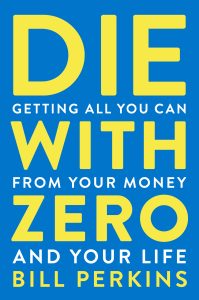
Books like Die With Zero talk about this idea clearly: money unused isn’t neutral—it’s opportunity lost.
The goal isn’t to maximize your portfolio.
The goal is to maximize a fulfilled life.
If you’re optimizing purely for financial safety while ignoring time, health, and presence—you might be missing the biggest return of all.
-End
Leave a Reply